SaaS Audit Logs: Why You Need Them and How to Build Them
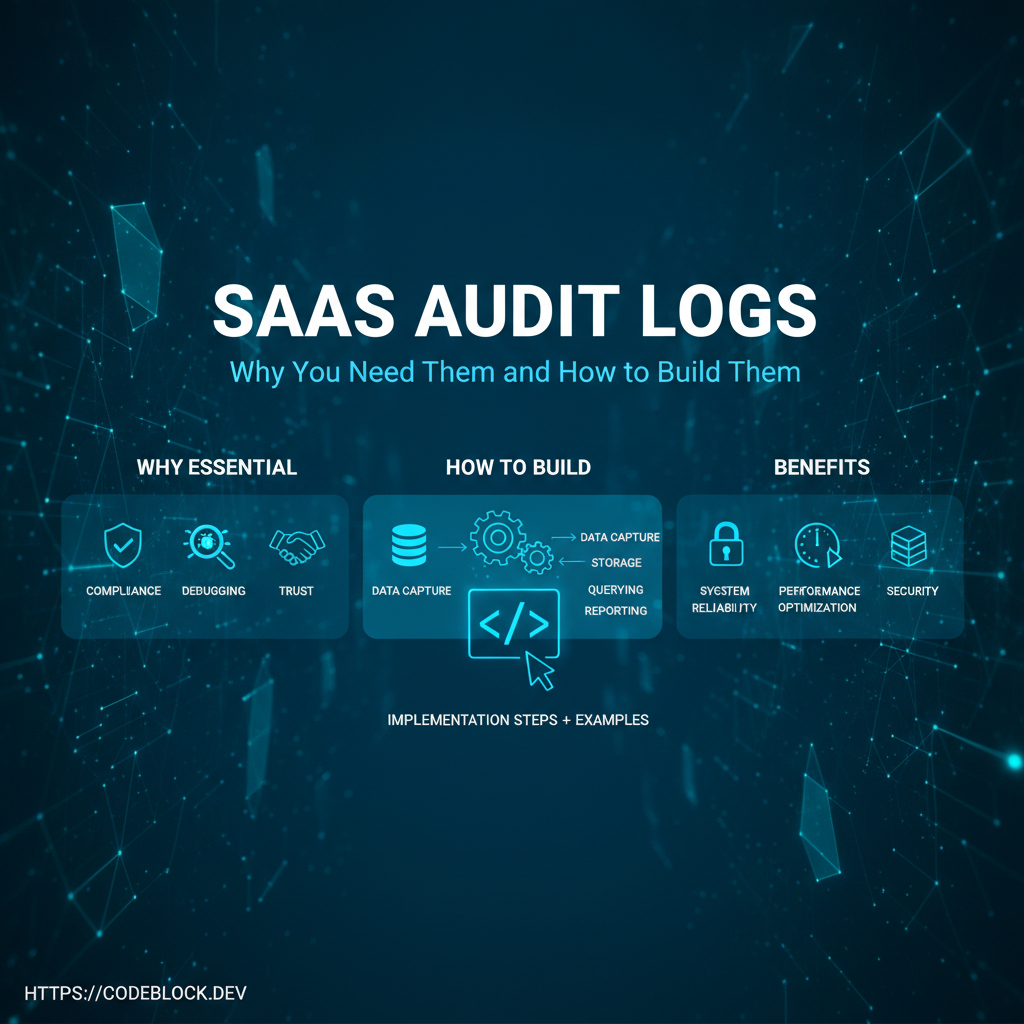
Audit logging separates professional SaaS from hacks. Used right, it protects your team from legal, user, and prod nightmares, and increases trust with customers, partners, and auditors. Here’s a best-practice 2026 playbook.
1. Why Audit Logs Matter (and When They're Required)
- Regulatory compliance: GDPR, HIPAA, SOX—user consent, security, export, and breach tracking
- Debugging: trace subtle, hard-to-reproduce bugs (“who changed what, when”)
- Support and trust: answer “who did what” for user questions, and surface history to admins/users
- Provenance and data defense: immutable data for key business/financial/PII changes
2. Anatomy of a Good Audit Log
- Track: who (actor/user), what (action/entity), when (timestamp), where (endpoint/IP), before/after values
- Make logs immutable (write-once), digitally signed if required
- Store logs securely, encrypted, and partitioned by tenant/account if multi-tenant
- Only log actions that matter for compliance/support; don’t add noise
- Give admins tools to search, filter, and export as needed for audits
3. Implementation Steps (.NET & SaaS Oriented)
- Use middleware/event handlers to record entity changes or key actions
- Log to a central, protected DB (with periodic cold/archive move for big data)
- Code sample for per-entity logging:
var auditLog = new AuditRecord {
    UserId = userId, Action = action, Entity = entity, Before = oldVal, After = newVal, Timestamp = DateTime.UtcNow
};
await auditDb.SaveAsync(auditLog);
- Secure access: only admin roles/privileged support can view, audit, or export
4. CodeBlock DevKit Audit Logging Module
- Entity change tracking, version history, full API/UI for admin review
- Export, search, and compliance features out of the box
- Integrated with all SaaS workflows (payment, plan changes, support intervention, PII access)
Audit Logging & Compliance Launch Checklist
- All key actions/entities logged (who/what/when/where/before/after)
- Immutable audit records, digital signatures where compliance requires
- Secure DB + archive + role-based access + search/export
- Regular admin/support review/testing
- Cold storage/archive policy
- Product docs/privacy updated to mention audit tracking
- Drill/test for compliance audit scenario
Explore further: