SaaS Multi-Tenancy Explained (Architecture, Patterns, and Trade-offs)
SaaS multi-tenancy means multiple customers (tenants) use the same application instance. Each tenant's data is isolated from every other tenant, but they all run on shared infrastructure - the same servers, the same codebase, and often the same database.
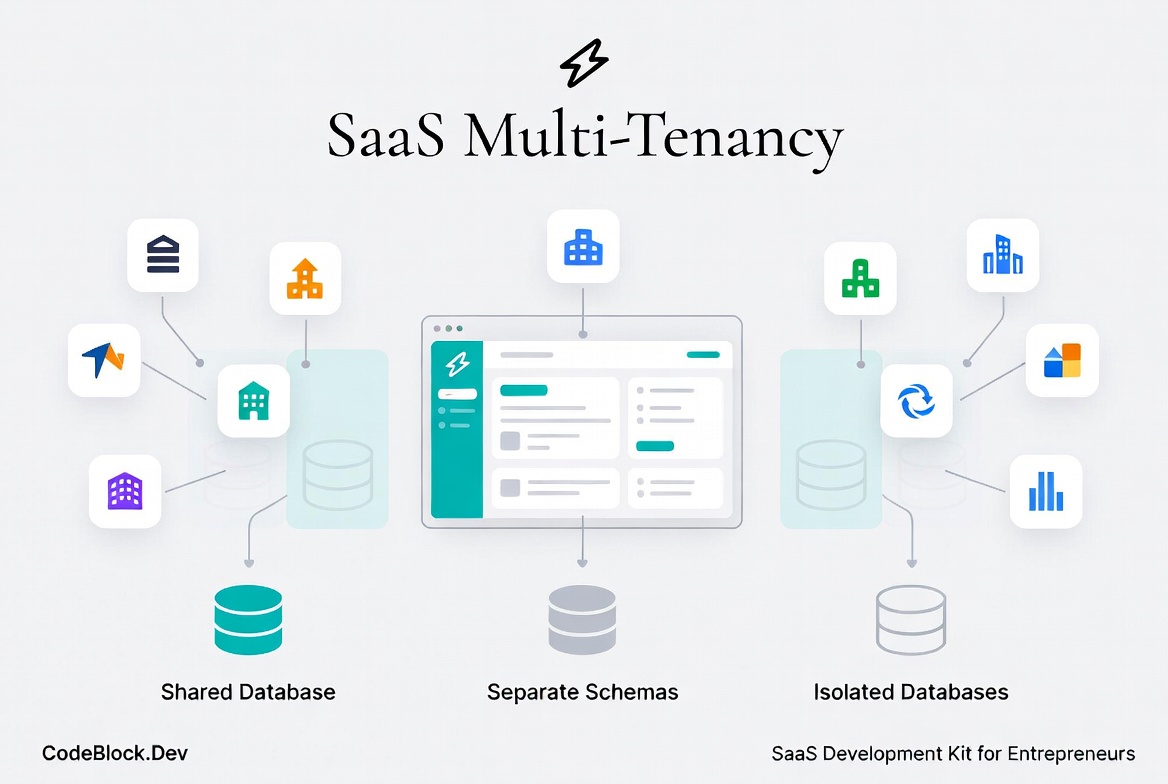 This is the default model for most SaaS products. It's what makes SaaS economically viable at scale: one deployment serves many customers, which keeps operational costs manageable.
The architecture challenge is isolation. How do you ensure that one tenant can never see, access, or affect another tenant's data - while still keeping the system efficient and maintainable?
The Three Main Approaches
1. Shared Database, Shared Schema (Row-Level Isolation)
All tenants share a single database with a single set of tables. Every data record includes a TenantId column, and all queries filter by that identifier to ensure each tenant only sees their own data.
How it works in practice: A Users table has a TenantId column. When a request comes in, the application resolves the current tenant from the request (usually from the subdomain, the JWT token, or a header) and applies a global query filter so that all queries automatically scope to that tenant.
Advantages:
- Lowest infrastructure cost: one database for all tenants
- Simplest to deploy and operate
- Easy to add new tenants: no database provisioning required
- Simple to run cross-tenant analytics if you ever need it
Disadvantages:
- A bug in the tenant filter can expose one tenant's data to another - this is the highest-consequence failure mode
- A noisy tenant (high query volume) affects all other tenants on the same database
- Per-tenant database customization (different schemas, column types) is impossible
- Regulated industries may require stricter data separation than this provides
Best for: Most B2C SaaS products, internal tools, and any product where tenants are individuals rather than enterprises.
2. Shared Database, Separate Schemas
All tenants use the same database server but each tenant gets their own schema (or in some databases, their own set of tables with a per-tenant prefix). The data is physically in the same place but logically separated.
How it works in practice: Tenant A's users live in tenant_a.users. Tenant B's users live in tenant_b.users. The application connects to the same database but routes queries to the correct schema based on the resolved tenant.
Advantages:
- Better isolation than row-level: a filter bug can't leak data across tenants because the schemas are separate
- Still manageable at medium scale before the schema proliferation becomes unwieldy
- Per-tenant customization is possible at the schema level
Disadvantages:
- Schema-per-tenant doesn't scale indefinitely; hundreds of schemas in one database becomes hard to manage
- Migrations get more complex: applying a schema change across all tenant schemas requires tooling
- Database backups and restores are more complicated
Best for: B2B products where tenants are companies with stronger isolation expectations, but the customer count doesn't justify fully isolated databases.
3. Database per Tenant (Full Isolation)
Each tenant gets their own dedicated database. The application resolves the tenant from the request and connects to the appropriate database for all operations.
How it works in practice: The system maintains a tenant registry that maps each tenant to its database connection string. On each request, the application looks up the tenant's database and creates a connection to it. All queries run against the tenant-specific database.
Advantages:
- Complete data isolation: one tenant's database cannot affect another's
- A noisy tenant only affects their own database
- Per-tenant customization, backup schedules, and compliance controls are straightforward
- Easier to meet enterprise and regulated-industry data requirements (GDPR data residency, for example)
Disadvantages:
- Highest operational cost: provisioning and maintaining a database per tenant doesn't scale economically to large numbers of small customers
- Cross-tenant operations (analytics, system-wide search) require aggregation across many databases
- Migrations must be applied to every tenant database - tooling to manage this is essential
- Provisioning new tenants requires infrastructure automation
Best for: Enterprise B2B SaaS, regulated industries, or products where tenants are large organizations with strict data separation requirements.
Choosing the Right Pattern
The honest answer is that most SaaS products should start with shared database, shared schema. It's the most manageable approach for early-stage products and covers the vast majority of use cases.
Move to schema separation or database-per-tenant when:
- You have B2B customers with explicit data isolation requirements in their contracts
- A tenant's query volume is genuinely affecting other tenants
- Your target market (healthcare, finance, government) requires it by regulation
Don't pre-optimize for isolation you don't need yet. The cost of operating a database-per-tenant architecture at 50 tenants is significant compared to the benefits, and migrating from shared schema to isolated when you actually need it is achievable.
Multi-Tenancy and Saas Multi-Tenancy Architecture in .NET
In ASP.NET Core, row-level isolation is typically implemented with EF Core's global query filters. You define a filter on the DbContext that automatically appends WHERE TenantId = @currentTenant to every query on every entity. The current tenant is resolved from the request pipeline and stored in a scoped service.
The tricky parts are:
- Ensuring the tenant resolver is correct and cannot be spoofed
- Making sure global query filters are applied consistently, including on navigation properties
- Handling tenant provisioning (creating the initial admin user, configuring the first plan)
- Admin queries that deliberately need to span tenants (system-level reporting, billing aggregation)
For the database-per-tenant pattern, the complexity shifts to connection management: the DbContext must resolve its connection string at request time, and EF Core migrations must be applied to each tenant's database independently.
What CodeBlock DevKit Handles
CodeBlock DevKit includes multi-tenancy support as part of its SaaS foundation. The tenant isolation model is built in, so global query filters, tenant resolution from the request, and tenant provisioning are handled before you write any product code. This removes the most dangerous part of implementing multitenancy saas: the risk of a query filter bug exposing one tenant's data to another.
For an overview of the other foundation layers a production SaaS needs alongside multi-tenancy, SaaS Foundations: The Hidden Work Behind a Real Product covers the full picture.