ASP.NET Boilerplate vs ABP Framework: What Developers Need to Know
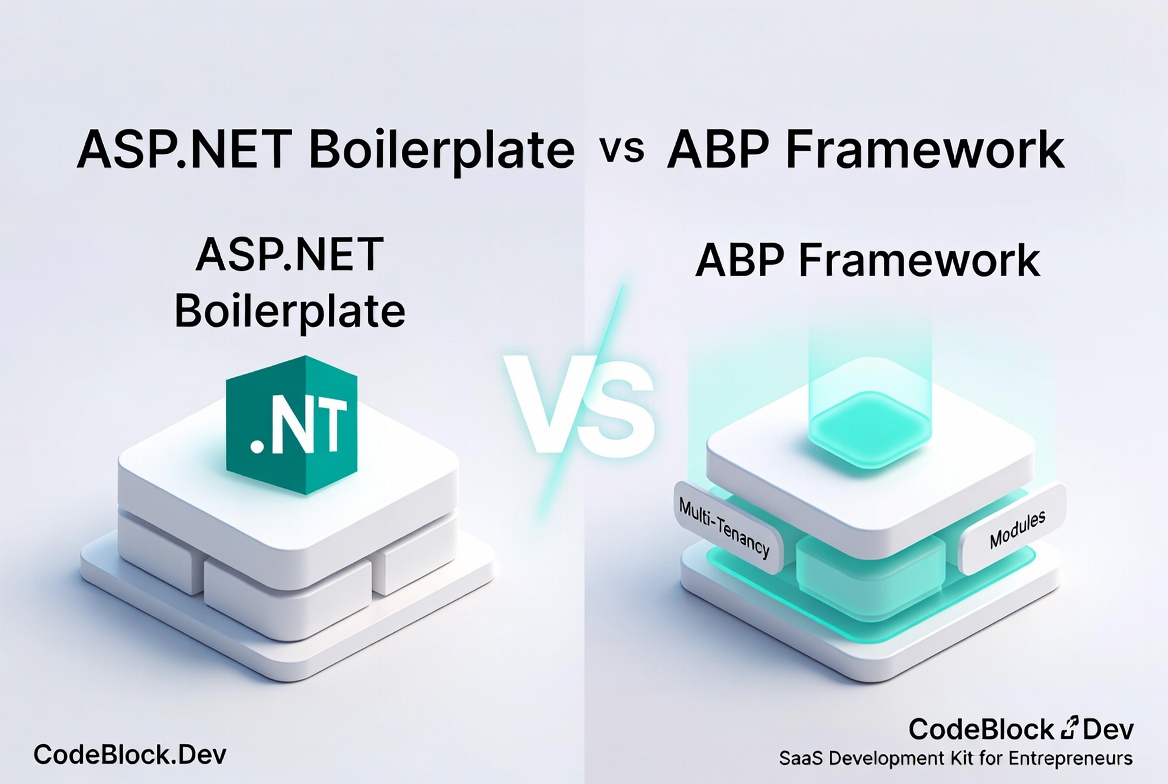
If you've searched for asp net boilerplate, you've almost certainly encountered two names: "ASP.NET Boilerplate" and "ABP Framework." These are not two competing products. They're the same product at two different points in its history - and understanding that relationship matters before you evaluate either one for a new project.
What ASP.NET Boilerplate Was
ASP.NET Boilerplate was an open-source application framework started by Halil Ibrahim Kalkan, released around 2013. It provided a layered architecture, dependency injection patterns, domain events, and a set of conventions for building N-tier ASP.NET applications. For its era, it was a genuinely useful starting point for developers who wanted a structured application framework rather than starting from a blank ASP.NET project.
The original framework targeted older .NET versions and was built around patterns common in enterprise .NET development at the time: NHibernate or EF6, ASP.NET MVC, and a service-layer architecture.
What ABP Framework Is
ABP Framework is the current evolution of ASP.NET Boilerplate, rewritten for modern .NET (ASP.NET Core) by the same author and now backed by a commercial company, Volosoft. The open-source version exists under the Apache 2.0 license, and a commercial tier (ABP Commercial) provides additional modules, themes, and support.
ABP Framework is a full application platform, not just a boilerplate. It includes:
- A complete modular architecture with its own DI conventions
- Multi-tenancy support built into the framework
- A domain events system
- The ABP CLI for code generation
- Pre-built modules for identity, tenant management, feature flags, background jobs, and more
- Optional front-end support for Angular, Blazor, and MVC
The scope is substantial. ABP Framework is designed to be the foundation of a long-lived enterprise application, and it imposes significant architectural decisions in return for that breadth.
The Core Trade-off with ABP Framework
ABP Framework's strength is its comprehensiveness. Its limitation is the same thing.
When you adopt ABP Framework, you adopt its conventions - module structure, application services, repository patterns, distributed event bus, and more. For teams with ABP experience, this is an accelerator. For teams learning it fresh, the learning curve is real, and the framework's opinions can feel constraining when your architecture doesn't align with what ABP expects.
The other consideration is project weight. ABP Framework adds substantial dependencies and abstractions. For a B2B SaaS product with complex business logic across a large team, that investment can be justified. For a focused SaaS product with a small team, it can add more overhead than value.
What Developers Are Usually Looking For
Most developers who search for "asp net boilerplate" are not specifically seeking ABP Framework's enterprise architecture. They want something that solves the repeated foundation work on every SaaS project: authentication, billing, subscriptions, admin tools, and roles. They want to get those pieces working without rebuilding them, then focus on the logic that's unique to their product.
That use case doesn't need a full application platform. It needs a focused SaaS foundation. The distinction matters because it changes what you evaluate. For an overview of what a .NET boilerplate should actually include, What Is a .NET Boilerplate? (And How It Speeds Up Development) covers the practical criteria.
When ABP Framework Makes Sense
ABP Framework is a reasonable choice when:
- You're building a large enterprise application with a big team and a long runway
- You or your team already have ABP experience and know how to work within its conventions
- You need ABP Commercial's specific modules (audit logging, language management, GDPR tools)
- Your architecture genuinely benefits from its distributed event bus and modular conventions
It's worth evaluating honestly for projects where the scope justifies the investment. For smaller or faster-moving SaaS products, the overhead-to-benefit ratio rarely works in its favor.
Where CodeBlock DevKit Fits
CodeBlock DevKit is a different kind of .NET SaaS foundation. Rather than a full application platform with its own architecture conventions, it's a set of NuGet packages that give you the SaaS-specific infrastructure your product needs: authentication with 2FA, Stripe-based subscription management, admin panel, role-based access, monitoring, job scheduling, and more.
The distribution model is worth noting: CodeBlock DevKit ships as versioned NuGet packages rather than source code you clone and own. That means updates come through package management, not manual merges. For a comparison of update strategies across .NET and other stacks, The Best SaaS Boilerplates in 2026 (Compared) covers this as a key selection criterion.
The SaaS template on GitHub shows a full application built on CodeBlock's modules - useful for understanding how the pieces fit before you start.
The right question isn't which .NET framework is "better." It's which one solves the specific problem you have: an enterprise application platform (ABP), or a focused SaaS foundation you can build a product on quickly (CodeBlock DevKit).
For a broader view of what SaaS founders consistently underestimate about the foundation layer, SaaS Foundations: The Hidden Work Behind a Real Product is worth reading before making any architectural commitment.