What Is a .NET Boilerplate? (And How It Speeds Up Development)
A .NET boilerplate is a pre-built ASP.NET Core application (or set of modules) that gives you a working foundation for a software project without building that foundation yourself. Instead of starting every project by writing auth, roles, logging, background jobs, and configuration from scratch, you start from a codebase where those pieces already exist and work together.
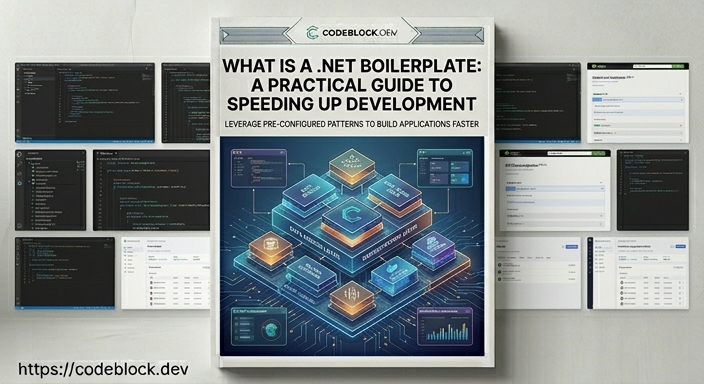 The term "boilerplate" in programming has always meant code that gets repeated across projects with little variation. A .NET boilerplate takes that concept a step further: rather than copying code between projects, you start from a structured, opinionated application that makes the common decisions for you.
What a .NET Boilerplate Typically Includes
A C# boilerplate for web application development typically covers:
Project structure: A layered architecture (domain, application, infrastructure, presentation) that separates concerns from the start. This matters more as the project grows - good structure at the beginning is much easier than refactoring it later.
Authentication and identity: User registration, login, session management, password reset, and email verification. These are present in almost every .NET application and require careful implementation to get right. A boilerplate handles the ASP.NET Core Identity setup, JWT or cookie configuration, and the flows that surround them.
Configuration and dependency injection: A consistent pattern for registering services, handling environment-specific configuration, and organizing startup code. This is low-value work that consumes more time than it should in a new project.
Logging and error handling: Structured logging, global exception handling, and a pattern for capturing meaningful diagnostics without noise.
Database access: A configured data access layer, usually Entity Framework Core or a NoSQL equivalent, with migrations handled from the start.
For SaaS projects specifically, a dotnet core boilerplate goes further:
Subscription billing: Stripe integration with webhook handling, plan management, renewal logic, and the edge cases (failed charges, proration, cancellation) that a basic integration misses.
Admin panel: A functional back-office for managing users, subscriptions, and system state. The Blazor-based admin panel in a .NET SaaS boilerplate gives operators real management capability, not just a data viewer.
Role-based access control: Permissions that carry through every layer of the application, not just a simple boolean flag per user.
Background jobs and monitoring: Scheduled tasks, retry policies, health checks, and the visibility into what the application is doing at any point.
How It Speeds Up Development
The time savings come from two places: the work you don't do, and the decisions you don't remake.
On the work side: authentication, billing, admin, and roles are solved before the first sprint. A team that builds these from scratch typically spends four to eight weeks on foundation before writing a line of product code. With an asp net boilerplate in place, that drops to days of setup and configuration.
On the decision side: a boilerplate makes choices about architecture, patterns, and tooling before you start. For experienced developers, this can feel constraining. In practice, it eliminates hours of discussion about things that don't differentiate your product - and that's almost always a net positive.
What to Look for in a .NET SaaS Boilerplate
Not all .NET boilerplates are equal. When evaluating one:
- Does it use current .NET versions, or is it targeting a deprecated release?
- Is the billing integration complete, including webhook handling and subscription renewal, or just a checkout form?
- Is the admin panel functional or decorative?
- How are updates handled? A boilerplate that ships as NuGet packages updates more cleanly than one that requires manually merging changed source files.
- Is it maintained? Check the commit history and open issue count.
An asp net boilerplate that checks these boxes is a significant time investment returned in the first project you build with it. One that doesn't will cost more time than building from scratch.
CodeBlock DevKit
For .NET developers building SaaS products, CodeBlock DevKit is a SaaS development kit that covers the full foundation: authentication, subscriptions, admin panel, roles, monitoring, job scheduling, localization, analytics, and more. It ships as NuGet packages rather than a clone-and-copy codebase, which means updates come through package management rather than manual merges.
The SaaS template on GitHub shows a complete application built on those modules - a working reference for how the pieces fit together before you start customizing.
For .NET developers who have built SaaS foundations before and know what's involved, CodeBlock DevKit is what the foundation looks like when someone else has already solved it.
If you're evaluating the difference between ASP.NET Boilerplate, ABP Framework, and more modern options, ASP.NET Boilerplate vs ABP Framework: What Developers Need to Know clarifies how those options relate and where each one fits. For a guide specifically focused on C# boilerplates and what they include, What Is a C# Boilerplate? A Guide for .NET Developers covers the concept from the language perspective.