How to Build a B2B SaaS Product (What's Different From B2C)
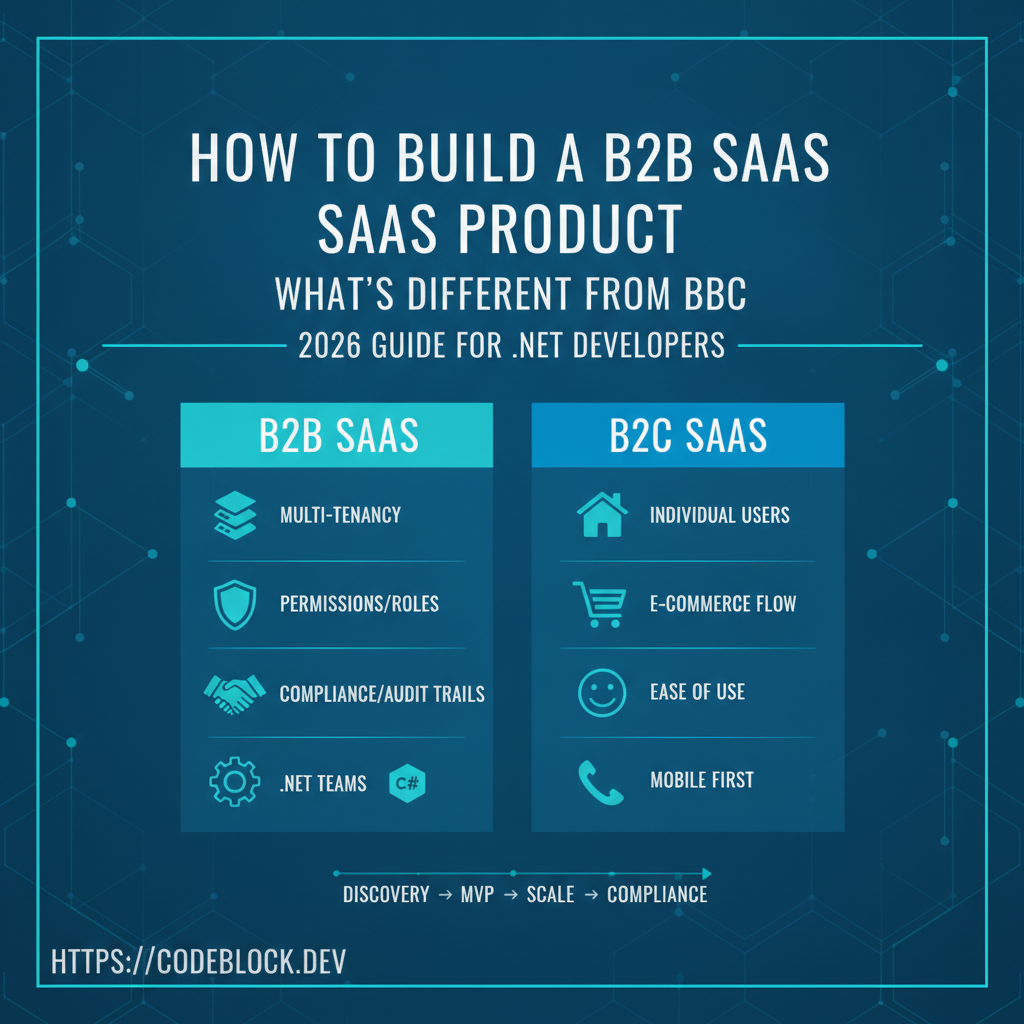
Launching a truly successful B2B SaaS doesn’t just mean porting over B2C playbooks. Business customers have fundamentally different needs: complex security and compliance, deep admin controls, team onboarding, and billing models that align with how companies buy software. Here’s how to architect, launch, and scale a B2B SaaS in 2026.
B2B vs B2C SaaS—Key Differences
- Customers: Companies (tenants/orgs/accounts) not individuals—expect bulk onboarding, contract cycles, multiple admins.
- Sales Cycles: Longer, with demos, legal reviews, proof-of-concept, and custom contracts.
- Usage Patterns: Multiple users per account, with role assignment, approval chains, SSO, cross-team access.
- Billing: Seat-based, by usage, or annual contracts. Invoicing and purchase orders are common.
The Heart of B2B: Multi-Tenancy
- Why it Matters: Firms want ALL their data, users, and settings segregated from other customers. Data leaks are an existential risk.
Multi-tenancy Patterns:
- Database-per-tenant: Every company gets its own DB. Max isolation, costly at scale.
- Schema-per-tenant: One DB, separate schemas. Good for medium scale, clear boundaries.
- Row-level (discriminator): Fastest to launch, all data in shared tables with tenant_id. Scale and performance require careful query handling and strict data checks.
Practical Tips:
- Always parameterize queries by tenant.
- Write matrix tests for cross-tenant data leakage—especially in exports, reporting, and background jobs.
- Secure ALL files/assets by tenant, not just DB rows.
- Support migration (moving a company to a new plan, region, or even out of your SaaS) via robust scripting.
Tenant Lifecycle: Onboarding, Upgrades, and Retention
- Team signup/invites: Collect minimal form at first; let first admin invite others, set up SSO, complete company profile.
- Role management: Define roles: Owner, Admin, Manager, Read-Only, Custom. Surface these in all controls.
- Contract upgrades: Support account upgrades, invoicing, and discounts—track terms per tenant.
- Offboarding: Cleanly delete data if requested (GDPR!), export company data, automate final invoice.
B2B Admin Controls—Matching Real Buyer Expectations
- Tenant admin panels: company-wide settings, users, subscriptions, audit logs, billing and support tickets.
- Permission model: Policy-based with role/group support. Let admins define custom permissions for sensitive features.
- SSO: Support SAML, Azure AD, Google Workspace, Okta, etc. Single sign-on is non-negotiable for mid-sized or larger customers.
- Billing: Allow company self-serve card purchases, but always offer "Request invoice" for enterprise buyers. Track all billing/contact history; automate reminder and renewal flows.
Compliance, Security, and Audit
- SOC2, GDPR, Data Residency: Understand requirements, document what’s done for each tenant. Keep audit logs of every privileged action.
- Access reviews: Let admins regularly review user access & permissions.
- Data residency: Some customers may request EU/US zone hosting—make this part of your offer if you can.
- Incident response: Pre-build admin UI to trigger data exports, lockouts, and breach notifications.
Advanced: Selling and Supporting B2B SaaS
- Custom onboarding: Demos, white-glove integrations, custom feature flags.
- Enable in-app chat/support with context (which user, which tenant, which plan).
- Offer API access and webhooks for enterprise integrations.
- Allow contract addenda: unique terms per tenant when negotiating larger deals.
Common Mistakes and How to Avoid Them
- Not enforcing tenant isolation everywhere (one export bug can leak another customer’s data)
- Missing SSO or sending shared login credentials
- No account-based audit logs—hard to prove compliance
- Treating all accounts the same: don’t overpromise to $10 users what you commit to a $10k+ tenant
CodeBlock DevKit and Production-Ready B2B SaaS
CodeBlock DevKit gives you:
- Built-in multi-tenancy (row-level and tenant-aware settings)
- Admin dashboards with full org/user control
- Audit logs, self-serve team onboarding, permission models, and SSO options out-of-the-box
- Automated GDPR/offboarding tools
- Enterprise-ready modules with minimal config—free up your team to focus on unique value, not repetitive SaaS plumbing
B2B SaaS Launch Checklist
- Multi-tenancy designed/enforced in DB, code, and assets
- Role-based admin controls and audit logs
- Self-serve and guided onboarding flows
- Billing per tenant—credit card, invoice, and PO options
- Regular access reviews and permission resets
- Data export/offboarding for compliance
- SSO (SAML, AD, Google, Okta) ready for mid/large clients
- Custom onboarding route for enterprise deals