How to Build a Production-Ready SaaS in .NET
Building your SaaS isn’t hard because your idea is complicated.
It’s hard because of everything around your idea: authentication, payments, subscriptions, admin tools, monitoring, localization, deployment and more than you expect.
If you’ve got your core idea, this is your practical shortcut to launching a real SaaS, one that’s production-ready, not just a demo.
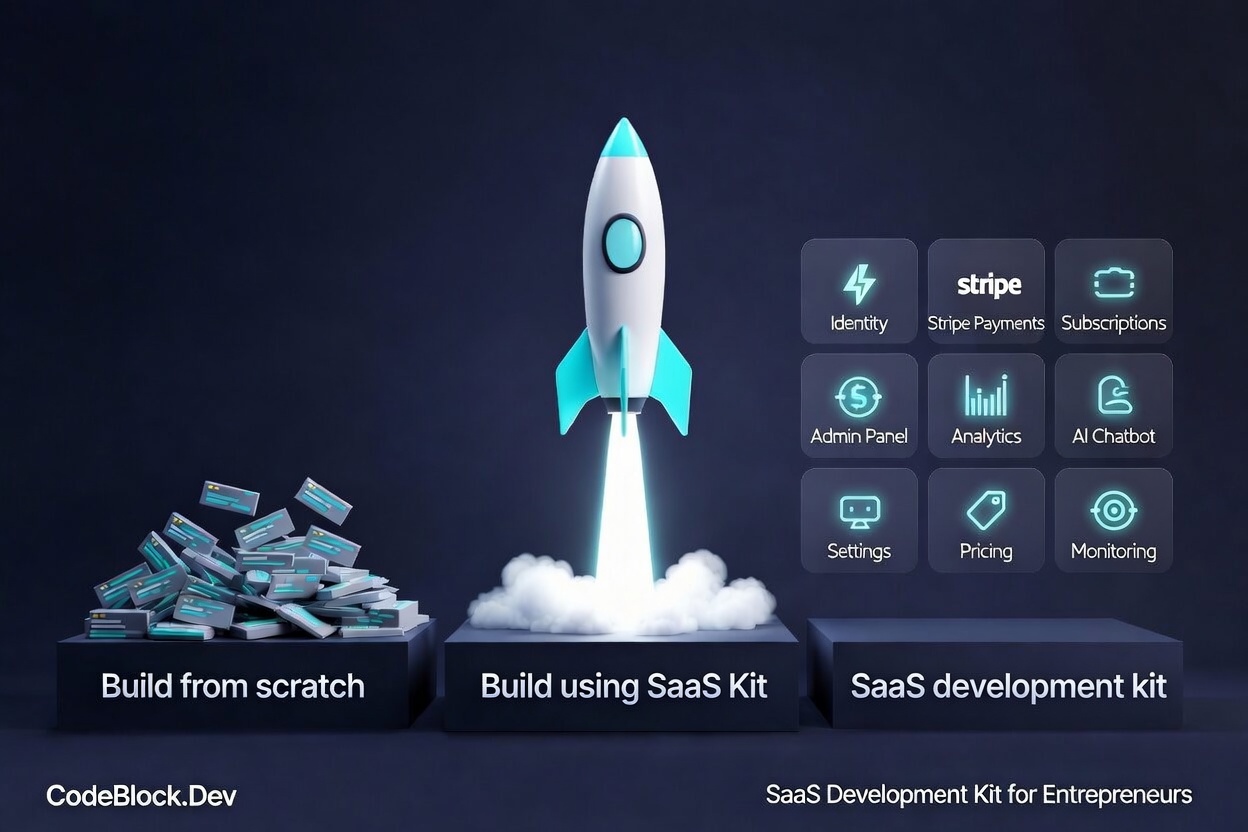
If you want a clear, non-technical intro to SaaS, start with What is SaaS? A simple guide (with a real example).
Why Most SaaS Projects Get Delayed
Almost every SaaS, regardless of what it does, needs:
- Secure authentication and authorization
- Payment and pricing (plans, renewals, upgrades)
- Admin and user panels
- Monitoring, logging, and audit trails
- Efficient deployment and maintenance
Rebuilding all of this from scratch burns months of your time, budget, and energy.
Skip “minimum viable product” dreams. If you launch with half of these missing, you’ll grind to a halt as soon as real users arrive.
What “Production-Ready” Actually Means
A true, production-ready SaaS (even for solo founders) needs much more than a working demo:
- Clean architecture that grows with your business logic
- Robust identity, roles, & permissions for secure access
- Pricing and subscriptions (upgrade, cancel, pro-rate support)
- Integrated payments (Stripe, etc.)
- Admin and user panels, because support matters
- Monitoring and change tracking for reliability
- Localization/globalization for multi-market growth
If any of these are missing, you’re not ready for production.
Should You Build or Buy Your Foundation?
Ask yourself:
- Is this feature (auth, billing, admin, etc.) my competitive edge, or do my users expect it “just to work”?
- Will people buy or stay because of custom infrastructure, or for what’s unique in my product?
- Do I want to maintain this code for years, or would I rather focus all energy on my real idea?
If these questions make you doubt, don’t reinvent the wheel.
Adopt a foundation you trust and invest your time in what only you can build.
Your Fastest .NET SaaS Launch Path (Step-by-Step)
1. Start With a Complete SaaS Template
Skip the barebones starter kits. Use a template that already contains real architecture, with identity, payments, admin UI, and more already wired up.
2. Configure Your Product (Not Just the Style)
Set up plans, subscription logic, branding, permissions, and any tenant rules before you write new features.
3. Code Only the Unique Value
Treat the template as your platform layer.
All the things every SaaS needs are handled, now add only the features that make yours special.
4. Deploy Fast & Learn in Production
Launch quickly, collect feedback from real users, and iterate.
Spending months on unseen foundation leads to “perfect code, no customers.”
CodeBlock DevKit: The Full SaaS Foundation for .NET
CodeBlock DevKit is a production-grade SaaS development kit for .NET teams and solo builders:
- Full SaaS application template
- Website, admin panel, and user panel, all integrated
- Core modules (Identity, Admin, Pricing, Payment, Subscription)
- AI Chatbot module for those training models
- Monitoring & change tracking
- Comprehensive documentation & REST API client
Get the up-to-date feature scope at codeblock.dev or check the docs at docs.codeblock.dev.
Who Wins With This Approach?
This shortcut is a game changer if you are:
- A solo founder with limited time (and patience for boilerplate)
- A backend developer who wants to ship faster (and avoid endless “setup”)
- A frontend dev who’d rather build UI than learn yet another backend
- A team focused on validating an idea before scaling
Mistakes to Avoid
The most expensive early SaaS mistake?
Optimizing for “developer comfort” instead of your users’ reality.
A hand-crafted backend may be satisfying, but your real edge is launching and learning fast, not admiring your code.
Your Real Advantage: Speed to Value
Real SaaS growth comes from putting your unique idea in users’ hands fast, then improving it week by week.
A dev kit like CodeBlock DevKit lets you skip the repetitive 80% so you can focus on the 20% nobody else can copy.
Final Test Before You Commit
Before you take a path, ask yourself:
How quickly can I get from “idea” to a real, production-ready SaaS with paying users?
If your answer isn’t “weeks, not months”, it’s time to use a better foundation.