SaaS vs PaaS vs IaaS: What's the Difference? (With Real Examples)
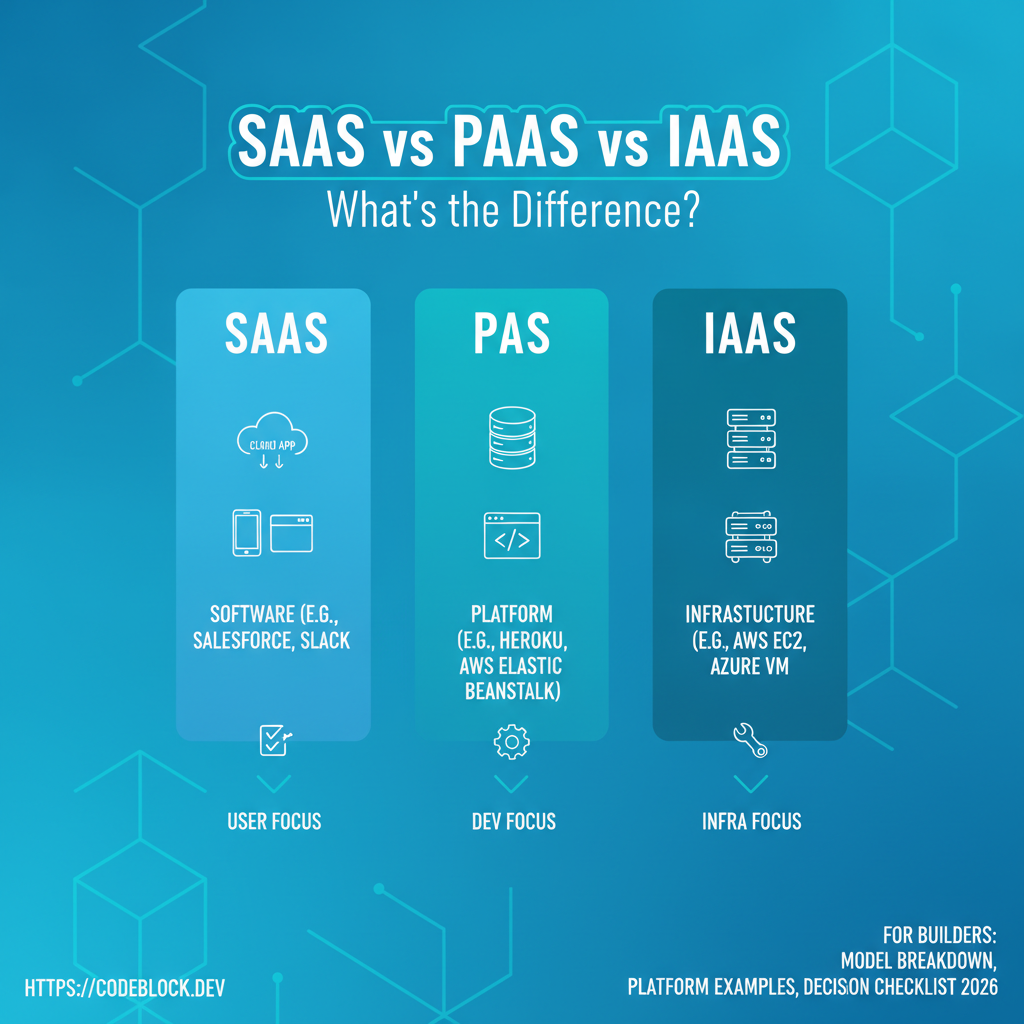
Too many "cloud" articles oversimplify: the real platforms you choose for your SaaS will affect speed, budget, security, and even investor confidence. This guide explains SaaS, PaaS, and IaaS for product founders and technical leads, using real production examples that actually inform buying and build decisions in 2026.
What is SaaS (Software as a Service)?
Definition: Software that runs in the cloud, fully hosted and managed by a provider. You use it in a browser or via API. You pay monthly or annually, and maintenance is invisible to you.
Real examples:
- Salesforce: full CRM, no infra to run
- Netflix: subscription streaming; zero customer hosting
- Gmail: managed business email, Google runs everything
For the founder: SaaS is your "done for you" model. Focus on using the service, not building infra. Security, scaling, and updates are handled by the provider. Downside: less control and limited customization.
Pro Tip: If you're building your own SaaS (product, platform, or even a micro-SaaS), a domain-optimized, production-ready foundation like CodeBlock DevKit gives you a jump start with robust modules for identity, billing, monitoring, and user onboarding—letting you focus on innovation, not infrastructure.
What is PaaS (Platform as a Service)?
Definition: Platforms that let you deploy and manage your own apps/code without managing the hardware. PaaS includes managed databases, app servers, and often CI/CD. You control your app; the provider controls infra and OS.
Real examples:
- Azure App Service: deploy .NET apps without worrying about servers
- Heroku: simple deploys, auto-scaling, fully managed
- Google App Engine: run code, Google handles OS and scaling
For the founder: PaaS gives flexibility to run custom code, with less DevOps overhead. Great for MVPs, experiments, and fast pivots. Caution: PaaS platforms may limit deep customization and can get expensive at scale.
What is IaaS (Infrastructure as a Service)?
Definition: Raw compute/storage/networking you rent on demand. You build (and secure) everything above the OS yourself. Highest flexibility, but highest maintenance.
Real examples:
- AWS EC2: launch VMs or entire networks
- Azure Virtual Machines: full Windows/Linux servers in the cloud
- DigitalOcean Droplets: affordable VMs
For the founder: IaaS is for those who need custom infra: custom OS, high-performance workloads, or regulated industries. More power, more responsibility: you manage patching, firewalls, and scaling.
Choosing Between SaaS, PaaS, and IaaS — Practical Scenarios
- Startup MVPs: Use SaaS tools and PaaS for core app hosting to move fast and minimize maintenance
- Growing Teams: Mix in PaaS for app logic and some IaaS as workloads scale
- Enterprise/Compliance: Heavy IaaS (for control/compliance), augmented with SaaS and PaaS for speed in non-regulated parts
Decision Checklist for SaaS Builders
- Are you prioritizing speed to market (choose SaaS/PaaS)?
- Do you require custom infra or compliance (may need IaaS)?
- Is your team strong in DevOps, or do you need a managed solution?
- Does your roadmap predict scaling quickly (watch for PaaS/IaaS limits)?
- Do costs/lock-in risk favor a mix of models?