What Is a SaaS Boilerplate? (And Why Every Developer Needs One)
A SaaS boilerplate is a pre-built starting point for a software-as-a-service application. It includes the infrastructure every SaaS needs: authentication, billing, admin tools, user management. The idea is simple - you skip writing that infrastructure yourself and start on your actual product instead.
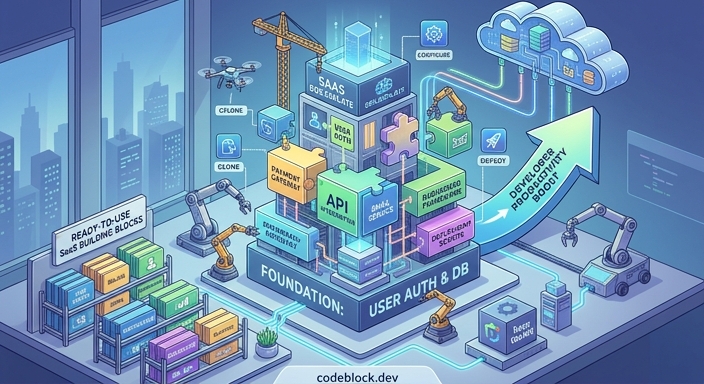
Why SaaS Boilerplates Exist
Every SaaS needs the same foundation, regardless of what the product actually does.
Whether you're building a project management tool, an AI assistant, or an invoicing app, you still need users who can sign up and log in, a way to charge money, admin tools, permission controls, and monitoring. None of this is your product. It's the scaffolding your product sits on.
The problem is that this scaffolding takes weeks - sometimes months - to build properly. Most developers underestimate how much complexity hides inside each of those areas. Payments alone involve trial periods, failed charges, proration, refunds, webhooks, and cancellation logic. Get any of it wrong and you have support problems before you have customers.
A boilerplate solves this by giving you a working implementation of all of it before you write a single line of business logic.
Boilerplate vs. SaaS Template vs. Starter Kit
These three terms are often used interchangeably. In practice, the differences are small:
- SaaS boilerplate: a code foundation with working modules, ready to extend
- SaaS template: often more UI-focused, sometimes a lightly-wired design without full backend logic
- SaaS starter kit: similar to a boilerplate, sometimes with tighter coupling to a specific framework or hosting provider
- SaaS scaffold: less common, usually means a code structure generated by a CLI tool
When someone says "saas starter kit" or "saas template," they usually mean the same thing a boilerplate means: a head start on the foundation, not a finished product. The label matters less than what's actually included.
What a Good SaaS Boilerplate Includes
A useful boilerplate covers more than just authentication. Here's what you should expect from a production-grade starting point:
Authentication and identity: Registration, login, email verification, password reset, two-factor auth, and social login. These need to be correct before anything else can work.
Subscription billing: Plan management, checkout, webhook processing, renewal logic, upgrade and downgrade flows, and refund handling. This is the part most developers get wrong when building from scratch - not because it's hard to start, but because the edge cases only show up later.
Admin panel: A back-office interface for managing users, viewing subscription status, applying discounts, and understanding what's happening in your system.
Role-based access control: Permissions for different user types (admin, staff, customer) that propagate through every part of the application.
Monitoring and health checks: Visibility into what's running, what's failing, and why.
A boilerplate that covers these gives you a real working product, not just code stubs. That distinction matters. You want something you can deploy and build against, not something that requires another month of wiring before it does anything useful.
What It Saves You
Building a solid SaaS foundation from scratch - one that handles payments correctly, covers auth edge cases, has an admin UI, and doesn't require constant firefighting - takes most experienced developers four to eight weeks. That's with no major bugs and no scope creep.
A boilerplate compresses that to days. You spend time learning the code, setting up your environment, and configuring integrations. The fundamental plumbing is already there.
For solo builders and small teams, this is often the difference between shipping in a month and shipping in a quarter. If you want to understand the full scope of what that plumbing involves, SaaS Foundations: The Hidden Work Behind a Real Product walks through exactly what gets built before users ever see a feature.
Who Uses Boilerplates
Boilerplates are not just for beginners who want to avoid complexity. They're used by experienced developers who have already built SaaS foundations before - and know exactly how long it takes - and don't want to do it again for every new project.
If you're still deciding what to build, finding and validating a good SaaS idea is already a serious challenge on its own. Spending half your runway on auth and billing infrastructure before you know if anyone wants your product is a mistake a boilerplate lets you avoid.
A .NET Option Worth Knowing
For .NET developers, CodeBlock DevKit is a SaaS boilerplate built as modular NuGet packages. It covers authentication, subscriptions, admin panel, monitoring, and other production requirements out of the box. There's also a full SaaS template on GitHub if you want to see how everything fits together before committing.
Final Thought
A SaaS boilerplate is not a shortcut for skipping a deep understanding of your stack. It's a way to skip rebuilding solved problems for the third time.
Your competitive advantage is what your product does, not how you wired up email verification. A boilerplate lets you put your time where it belongs: on the thing that makes your SaaS worth using.
When you're ready to evaluate specific options on GitHub, SaaS Boilerplate on GitHub: What to Look for Before You Clone covers the checklist: license, maintenance, billing completeness, and what the admin panel actually needs to do.