Laravel SaaS Boilerplate vs .NET SaaS Boilerplate: Which Is Right for You?
Laravel and .NET are both mature, capable frameworks for building SaaS products. The developers using each one tend to come from different backgrounds, serve different parts of the market, and have different strengths at the product layer. This comparison is not a case for switching stacks - it's a practical guide for developers who are genuinely evaluating both options, or PHP developers curious about what .NET brings to the table.
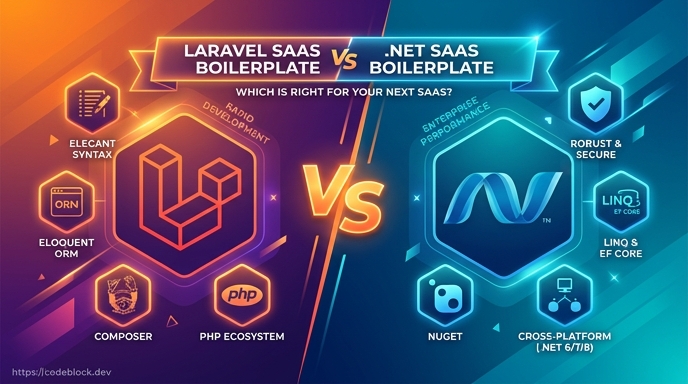
What the Laravel SaaS Ecosystem Looks Like
Laravel has a solid set of SaaS boilerplate options. Wave is a long-standing open-source option. Larafast is a newer commercial product. Spark, Laravel's own subscriptions package, gives you billing infrastructure as an add-on. Jetstream handles auth scaffolding.
The ecosystem's strengths are the same as Laravel's strengths:
- A large, active PHP developer community with well-documented patterns
- Eloquent ORM that makes most database interactions fast to write
- Built-in queue systems, broadcasting, and job scheduling
- Familiar conventions across the ecosystem that reduce context-switching
- Strong selection of free and paid packages for common SaaS needs
A Laravel developer can start a new SaaS project with Jetstream, Spark, and Livewire and have a working foundation relatively quickly - assuming they already know the framework.
What varies significantly across Laravel boilerplate options is billing depth. Some include full webhook handling and subscription lifecycle management. Others are thin wrappers around Stripe Checkout that stop at the success page. Before choosing any Laravel option, verify the billing completeness explicitly. SaaS Boilerplate on GitHub: What to Look for Before You Clone covers exactly what to check.
What the .NET SaaS Ecosystem Looks Like
The .NET SaaS boilerplate ecosystem is smaller but focused. The primary production-ready option for .NET developers is CodeBlock DevKit, which delivers SaaS infrastructure as NuGet packages rather than a cloned codebase.
.NET's strengths for SaaS development:
- ASP.NET Core's performance and request handling are strong under sustained load
- C# is a strongly typed, compiled language that catches errors at build time
- The ecosystem for background processing, health monitoring, and enterprise integrations is mature
- Entity Framework Core handles complex data models well
- The deployment story is flexible: Windows, Linux, Docker, Azure, AWS
Where .NET has historically been less convenient is in the "first deploy" time. Setting up a .NET project, configuring it, and getting it deployed takes more steps than pushing a Laravel app to shared hosting. For developers coming from PHP, this gap is real. Cloud hosting platforms have closed it considerably, but it's worth acknowledging.
Where Each Stack Wins
Laravel wins on:
- Rapid early-stage development for developers fluent in PHP
- A very large talent pool if you plan to hire
- Shared hosting and low-cost deployment options for early products
- An opinionated set of conventions that remove decision fatigue for standard patterns
NET wins on:
- Complex server-side logic, background processing, and enterprise integrations
- Long-term type safety and refactoring support in larger codebases
- B2B and enterprise customers who expect .NET-native security and compliance patterns
- The NuGet package update model, which keeps boilerplate updates cleaner over time
- Performance under sustained high-concurrency load
For a full breakdown of what a .NET SaaS boilerplate includes and what its update model means in practice, What Is a .NET Boilerplate? (And How It Speeds Up Development) covers both.
Side-by-Side Comparison
| Factor | Laravel boilerplate | .NET boilerplate |
|---|---|---|
| Best team fit | PHP developers | C# and .NET developers |
| Time to first deploy | Fast (familiar PHP hosting) | Moderate (more setup, better tools) |
| Backend logic handling | Good for most SaaS use cases | Strong for complex, stateful logic |
| Type safety | PHP type hints (partial) | C# (fully typed, compiled) |
| Enterprise feature depth | Good, varies by product | Strong, consistent across .NET |
| Update strategy | Manual source merge | NuGet packages (CodeBlock) |
| Talent pool for hiring | Large (PHP) | Solid, enterprise-skewing |
| Community and docs | Very large | Strong, Microsoft-backed |
The Billing Overlap
Both ecosystems can deliver complete subscription billing. The difference is not the stack - it's whether the specific boilerplate you choose did the work.
A proper subscription billing implementation covers Stripe webhooks, renewal logic, failed payment handling, plan changes, and access revocation on cancellation. In both Laravel and .NET, these pieces exist and can be done well. In both ecosystems, cheaper or older boilerplates often skip the hard parts. SaaS Subscription Management: What You Need to Build details the full lifecycle so you know what to ask for when evaluating any option.
The Recommendation
If you're a PHP developer and Laravel is where you're productive, use a Laravel SaaS boilerplate. There's no reason to switch stacks for a boilerplate comparison.
If you're a .NET developer, or your team skews .NET, or you're building a product where backend complexity, enterprise integrations, or long-term maintainability are the deciding factors, a .NET boilerplate is the right foundation. The investment in .NET's type safety and the NuGet update model pays back over time in a way PHP applications typically don't.
If you're a PHP developer considering .NET for the first time, the most honest advice is: evaluate the switch based on your product requirements and your team's background, not on the boilerplate comparison alone.
CodeBlock DevKit for .NET
For .NET developers, CodeBlock DevKit provides a complete SaaS foundation: authentication with 2FA and social login, Stripe-based subscription management, admin panel, role-based access, monitoring, and more. The SaaS template on GitHub shows everything working together before you start.