Next.js SaaS Boilerplate vs .NET SaaS Boilerplate: Which to Choose?
Both Next.js and .NET have solid SaaS boilerplate options. Picking between them is not about which stack is objectively better - it's about which one fits your background, your team, and the specific demands of the product you're building.
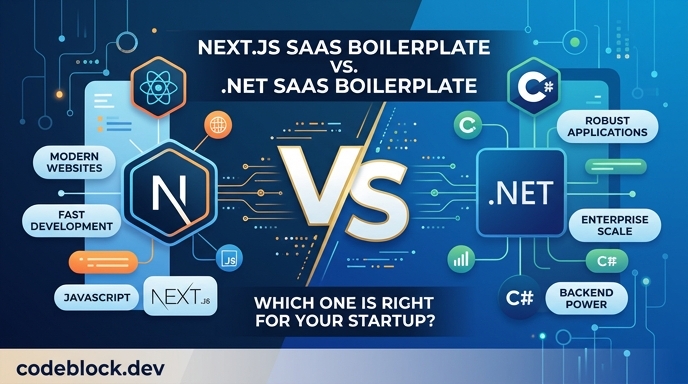 This comparison is for developers who are at that decision point: you know roughly what you want to build, you've heard of options in both ecosystems, and you want an honest read on where each one wins and where it struggles.
What Each Ecosystem Offers
Next.js SaaS boilerplates target JavaScript and TypeScript developers. They pair naturally with Vercel's deployment platform and front-end-heavy workflows. The React component ecosystem is large, UI work tends to move quickly, and the path from clone to deployed URL is short when you're already comfortable with TypeScript. ShipFast is the most prominent option in this category.
NET SaaS boilerplates serve a different kind of developer: backend-first, often with enterprise or line-of-business experience, building products where the server-side logic is the core of what they're delivering. ASP.NET Core is mature, strongly typed, and well-suited to complex business logic, background processing, and system integrations. The tooling ecosystem around things like EF Core migrations, dependency injection, and health monitoring has been refined over many years.
For a broader comparison across all major stacks, The Best SaaS Boilerplates in 2026 (Compared) covers options across Next.js, Python, PHP, and .NET in more detail.
Where Next.js Boilerplates Win
Frontend speed and flexibility. React's component model and the Next.js App Router make it straightforward to build polished UIs quickly. If your team skews toward frontend developers, or your product is UI-heavy (dashboards, real-time collaboration, visual tools), Next.js lets you move fast there.
Deployment simplicity. Vercel handles most hosting complexity for Next.js projects. Edge functions, serverless deployments, and preview environments ship with almost no configuration. This matters most for solo founders and early-stage products that don't want to manage infrastructure manually.
npm ecosystem breadth. Need a library for something specific? It almost certainly exists on npm. The JavaScript ecosystem is enormous, and Next.js benefits from all of it.
Low barrier to first deployment. A developer already fluent in TypeScript can have a Next.js SaaS boilerplate running locally and deployed within a few hours. There is almost no stack tax when the framework is familiar.
Where .NET Boilerplates Win
Backend complexity. When your product involves complex workflows, multi-step transactions, background processing, or heavy server-side computation, ASP.NET Core handles this with more structure than a Next.js API route. The separation between domain logic, application services, and infrastructure is built into .NET conventions in a way that scales as the codebase grows.
Enterprise integration. If you're selling to mid-market or enterprise customers, you'll eventually need things like fine-grained role-based access, audit logging, compliance controls, and service-to-service authentication. .NET has decades of tooling and patterns for this.
Multi-tenancy at scale. .NET's threading model and request handling perform well under sustained load with complex multi-tenant isolation logic. For the architectural patterns behind this, SaaS Multi-Tenancy Explained covers the options and their trade-offs in full.
Type safety and long-term maintainability. C# is a strongly typed, compiled language with mature tooling for refactoring, testing, and catching errors before they reach production. For larger teams or longer-lived products, this pays dividends.
Module-based updates. Most boilerplates ship as source code you clone and modify. When the boilerplate releases updates, you merge them manually. .NET SaaS boilerplates that ship as NuGet packages (like CodeBlock DevKit) let updates come through package management instead. For a production app that evolves over years, this is a real maintenance advantage. What Is a .NET Boilerplate? explains what this distribution model means in practice.
Side-by-Side Comparison
| Factor | Next.js boilerplate | .NET boilerplate |
|---|---|---|
| Best stack fit | JS/TS frontend developers | Backend and enterprise .NET developers |
| UI development speed | Fast (React ecosystem) | Capable (Blazor, different model) |
| Deployment simplicity | Very simple (Vercel) | Flexible (Azure, AWS, self-hosted) |
| Backend complexity handling | Good for light to medium logic | Strong for complex, stateful business logic |
| Enterprise and B2B features | Varies by product | Strong (roles, audit, compliance patterns) |
| Update strategy | Manual merge of source | NuGet packages for CodeBlock DevKit |
| Multi-tenancy support | Custom work required | Built-in patterns in .NET ecosystem |
| Typical best fit | Solo founders, indie SaaS, consumer apps | B2B SaaS, enterprise tools, .NET teams |
The Decision
Choose a Next.js SaaS boilerplate when your team already knows TypeScript and React, your product is frontend-heavy or benefits from serverless deployment, you're building a consumer-facing app, or getting to a deployed URL fast is the priority.
Choose a .NET SaaS boilerplate when your team comes from a .NET or enterprise background, your product logic is complex (multi-step workflows, background jobs, service integrations), you're targeting B2B or enterprise customers with strict requirements, or you want clean module-based updates over manual source merges.
The stack you already know is almost always the right stack to start with. What matters more than the framework choice is whether the boilerplate you pick covers the complete SaaS foundation: working auth, real billing logic, a functional admin panel, and an actively maintained codebase. What Is a SaaS Boilerplate? covers what that foundation must include before you commit to any option.
CodeBlock DevKit for .NET
For .NET developers, CodeBlock DevKit is a SaaS development kit covering the full foundation: authentication with 2FA and social login, multi-tenant subscription management via Stripe, admin panel, role-based access control, monitoring, job scheduling, and more. It ships as NuGet packages rather than a clone-and-copy codebase, which keeps the update path clean as your product evolves.
The SaaS template on GitHub shows a complete working application built on those modules.