React SaaS Template vs Blazor SaaS Template: A Developer's Take
The React vs Blazor debate for SaaS frontends is not one where there's a wrong answer - but there is a right answer for your specific situation. This comparison is for developers who are actually choosing between the two, not for generating abstract arguments about which technology is superior.
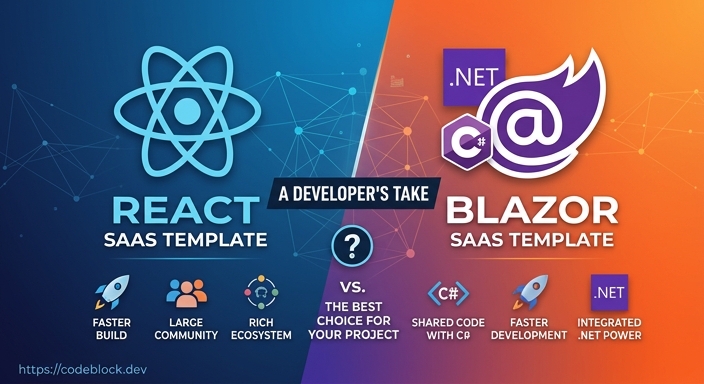 If you're a .NET developer evaluating your frontend options, or a React developer wondering whether Blazor has caught up, here is the honest breakdown.
What React SaaS Templates Offer
React has a large SaaS template ecosystem. ShipFast, Makerkit, Supastarter, and others all use React (typically with Next.js) as the frontend. The appeal is straightforward: React is the dominant frontend framework, the component library options are enormous, and most frontend developers already know it.
A React SaaS template typically gives you:
- A polished set of frontend components (dashboards, pricing pages, auth screens)
- Next.js routing and API routes for basic backend needs
- Stripe integration via JavaScript libraries
- Fast iteration on UI, especially for teams with React experience
The honest limitation is that React API routes are not a serious backend. For SaaS products where server-side logic is complex - background jobs, complex billing scenarios, service integrations - Next.js API routes become a bottleneck. You end up adding a separate backend anyway, at which point the template's frontend value starts to carry more weight than the backend features.
What Blazor SaaS Templates Offer
Blazor is Microsoft's framework for building web UIs with C#. It lets .NET developers write component-based UIs without switching to JavaScript. A Blazor SaaS template combines a Blazor frontend with an ASP.NET Core backend in a single, unified .NET application.
What this gives you in practice:
- Shared models and business logic between frontend and backend, in a single language
- Access to the full .NET ecosystem on the server side
- Strong typing throughout, including API contracts
- No context-switching between JavaScript and C# when debugging
- A backend that can handle complex logic, background processing, and enterprise integrations natively
The honest limitation is that Blazor's UI component ecosystem is smaller than React's, and developers who don't already know C# face a learning curve. There are also hosting considerations: Blazor Server requires a persistent connection, and Blazor WebAssembly has initial load time trade-offs worth understanding before committing.
The Stack Fit Question
The most common mistake in this comparison is evaluating the frameworks without accounting for who is doing the building.
For a team that primarily writes JavaScript and TypeScript, React is the faster choice. The productivity advantage of using a familiar framework is real, and a React SaaS template in the hands of experienced JS developers will ship faster than a Blazor template that requires a framework ramp-up.
For a team that primarily works in .NET and C#, Blazor changes the equation completely. Using Blazor means staying in a language and runtime you already know, while getting a capable component model for the frontend. The combined .NET stack - shared models, unified debugging, a single deployment artifact - is a significant productivity advantage for .NET shops. What Is a .NET Boilerplate? explains what a complete .NET SaaS starting point includes.
Where Blazor Specifically Wins
Backend complexity is your core product. If your SaaS is built around complex data processing, background jobs, integrations with enterprise systems, or multi-step workflows, the .NET backend is where most of the value lives. Blazor lets you keep everything in one codebase and one language. That cohesion pays off as the application grows.
B2B and enterprise requirements. Role-based access control, audit logging, fine-grained permissions, multi-tenancy, and compliance tooling are all better-served by the .NET ecosystem than by API routes. For the multi-tenancy side of this, SaaS Multi-Tenancy Explained covers what the architectural options look like.
Long-term maintainability. C# is a compiled, strongly typed language. Refactoring a Blazor SaaS application as it grows is less brittle than the equivalent TypeScript/React codebase, especially for developers more experienced with static typing.
Where React Specifically Wins
UI-heavy products. If your product lives or dies on the quality and variety of its UI (interactive dashboards, drag-and-drop workflows, real-time visual tools), React's component ecosystem is unmatched. The available libraries, tooling, and community answers to UI problems are much deeper in React.
Serverless and edge deployment. Vercel's deployment model for Next.js is hard to beat for simplicity. If you want to deploy with zero infrastructure management and scale on demand, a React SaaS template on Vercel is the fastest path.
Recruiting and team growth. If you anticipate hiring frontend developers, React is a broader talent pool. Blazor developers exist and the number is growing, but the React developer market is larger.
Side-by-Side Summary
| Factor | React SaaS template | Blazor SaaS template |
|---|---|---|
| Best team fit | JS/TS frontend developers | .NET and C# developers |
| UI component ecosystem | Very large | Growing, capable |
| Backend capability | API routes (limited for complexity) | Full ASP.NET Core |
| Shared language across stack | No (JS front, separate back) | Yes (C# throughout) |
| Hosting simplicity | Vercel (very simple) | Azure, Docker, self-hosted |
| Enterprise and B2B features | Requires custom work | Strong native support |
| Long-term type safety | TypeScript (good) | C# (strong) |
The Recommendation
If you're a .NET developer, use Blazor. The combined-stack advantage, the depth of the ASP.NET Core backend, and the ability to stay in one language throughout will outweigh the smaller UI library selection. You won't have to context-switch, and the foundation modules available through a .NET SaaS template are genuinely comprehensive.
If you're a JavaScript developer and React is your primary language, use a React SaaS template. Don't switch stacks to use a different framework. The stack you know is the stack you'll ship faster with.
For a broader view of what any SaaS template should include regardless of stack, What Is a SaaS Template? A Practical Guide for Builders covers the criteria that matter for production use.
CodeBlock DevKit for Blazor
For .NET developers choosing the Blazor path, CodeBlock DevKit provides a complete SaaS foundation as NuGet packages: authentication with 2FA, Stripe-based subscriptions, admin panel, role-based access, monitoring, and more. The SaaS template on GitHub shows a full Blazor SaaS application built on those modules.